Thoughts from a Small Business Owner
There’s something that happens when you walk into a place and the owner knows your name.
Not because they scanned your loyalty card or pulled up your order history on a screen — but because they remember you. They remember that you prefer your wine poured light, or that you came in last month celebrating something, or that you looked like you needed a quiet corner and they gave you one without being asked. That kind of knowing isn’t a feature of any app. It can’t be franchised. It lives in the particular warmth of a particular person who chose to build something real in the place where they live.
That’s what a small business actually is. Not a storefront. Not a revenue stream. A person — or a small group of people — who bet everything on something they love, and invited their community in.
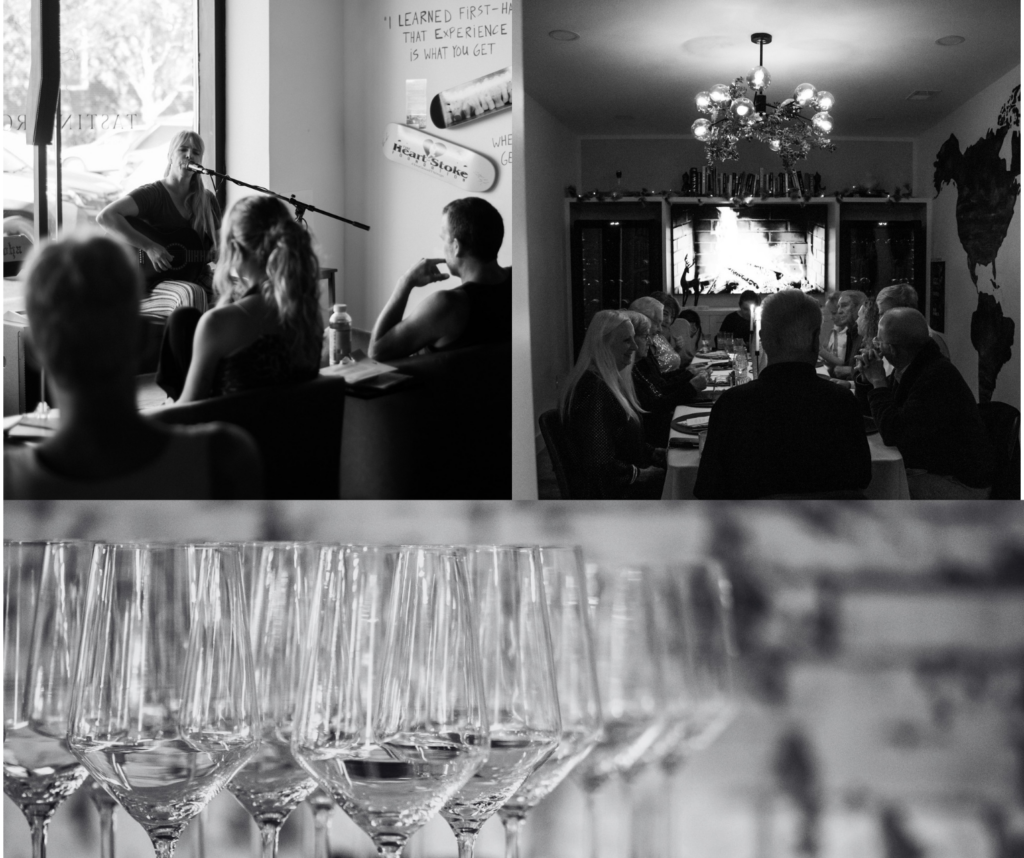
Walk through almost any neighborhood and you can feel the difference between a block that’s alive and one that isn’t. The alive ones have a wine bar where the owner is also the one behind the bar on a Tuesday night, genuinely curious about your day. A place like TTR — intimate, personal, the kind of spot where conversations happen between strangers and regulars find themselves becoming friends. These spaces do something that a chain or a big-box retailer simply cannot replicate: they hold community. The owner sets the tone. The few employees who work there carry that tone with them. The regulars absorb it. And slowly, organically, a neighborhood becomes a neighborhood because of it.
This is not nostalgia. This is not romanticism about a simpler time. This is about something fundamental to what it means to be human.
We are wired for connection. For being seen, recognized, welcomed. For third places — spaces that are neither home nor work but somewhere in between, where the normal rules relax and people can just be people together. For most of human history, those spaces were owned and run by the very people who lived among us. The butcher on the corner. The bookshop owner who’d hold a copy for you. The wine bar where the person pouring actually chose every bottle because they cared about what you’d taste. These weren’t just transactions. They were the texture of daily life.
When we lose those places, we lose more than convenience. We lose the connective tissue of a neighborhood.
Right now, many of us are living through an economy that asks us to pull back. To be careful. To prioritize. And that instinct is understandable — but it can come with a cost that doesn’t show up on any receipt. When we scale back our spending, we tend to default to the easiest and cheapest options. And those options are almost always the large ones: the platforms, the chains, the corporations with the infrastructure to absorb the pressure of a slow month or a bad year.
Small businesses don’t have that cushion. They are, in the most literal sense, operating check to check. The money you spend on a Thursday evening is what covers payroll on Friday. The owner who greets you at the door is also the one who does the books at midnight, troubleshoots the heating system, orders the inventory, and wakes up at 3am running the numbers again. There is no parent company absorbing the loss. There is no board of directors deciding to keep the location open as a strategic investment. There is just a person — your neighbor, your friend, someone’s parent, someone’s kid — who decided that what they wanted to do with their life was build something for their community.
That is a profound and courageous thing. And it is fragile.
The people who run small businesses are not doing it for the money — because if money were the primary motivation, they would do almost anything else. They do it because they love what they do. The owner of a wine bar loves wine, yes, but more than that they love the ritual of hospitality. They love the moment a guest discovers something new in a glass. They love being the place someone comes to decompress, to celebrate, to meet, to belong.
That love is exactly what makes these places worth saving. It’s what you taste in the food, hear in the music selection, feel in the atmosphere of a room that someone cared deeply about creating. You cannot manufacture that quality in a corporate boardroom. You cannot A/B test it into existence. It comes from someone who is personally, emotionally invested in the experience of every single person who walks through their door.
Supporting that person isn’t charity. It’s an investment in the kind of place you want to live.
A neighborhood is only as real as the people in it. When the storefronts are all chains — identical menus, corporate interiors, staff who are employed but not invested — a neighborhood stops being a neighborhood. It becomes a backdrop. Somewhere you pass through rather than somewhere you belong.
The privately owned spaces, the ones with the owner behind the counter and two or three people who genuinely care about what they’re doing, are what make a place particular. What make it yours. What give it a story. When you walk into TTR or any small business like it, you’re not walking into a brand. You’re walking into someone’s vision of what a good life looks like — and they’ve opened that vision up and invited you inside.
That’s worth protecting. That’s worth choosing, even when the easier option exists.
So the next time you’re deciding where to spend an evening, where to grab a bottle, where to mark an occasion — consider the small place. The one where somebody you know probably owns it. The one where the walls have a little history and the people behind the bar have actual opinions. The one that’s been there through the hard years because the community kept showing up
Show up.
Because the strongest communities are not built by corporations. They’re built by neighbors — and the small businesses they sustain.